Marketing Leadership
When Does a Growing Business Need Senior Marketing Leadership?

As businesses grow, marketing tends to become more complicated before it becomes more sophisticated.
More channels are introduced. More campaigns are launched. Agencies and specialists become involved. Sales expectations increase. Budgets grow.
But the marketing function itself doesn't always mature at the same pace.
The result can be a business doing considerably more marketing without being sufficiently clear about what marketing should actually achieve, where investment should be focused or how different activities contribute to growth.
At this point, the answer isn't necessarily another campaign, another specialist or even another full-time hire.
Sometimes what the business is missing is senior marketing leadership.
The challenge is recognising when that need has emerged.
Marketing capability and marketing leadership aren't the same thing
A business can have plenty of marketing capability without having effective marketing leadership.
An internal marketer may be doing excellent work. Agencies may be performing well within their individual remits. Freelancers and specialists may bring valuable expertise.
But somebody still needs to connect those activities to the wider commercial strategy.
That means answering questions such as:
What are we trying to achieve?
Which markets and customers should we prioritise?
What should we be known for?
Where should we invest?
What should we stop doing?
How should marketing support sales?
And how will we know whether it's working?
These are leadership questions rather than execution questions.
The more marketing activity a business has, the more important it becomes to have someone deciding what that activity should collectively achieve.
Without that direction, capable people can end up working hard against unclear or competing priorities.
The leadership gap often appears during growth
Early-stage businesses rarely start with sophisticated marketing functions.
The founder may initially own the proposition, messaging, sales and much of the marketing.
As the business grows, responsibilities gradually become distributed.
A marketer is hired.
An agency takes responsibility for paid activity.
Someone manages the website.
Sales develops its own collateral.
Content gets produced.
Different people start making decisions about different parts of the customer journey.
This is a natural stage of growth.
But it can create a gap between doing marketing and leading marketing.
For funded businesses, that gap can become particularly visible after investment. Expectations increase quickly, new resources become available and there is pressure to demonstrate growth.
For established businesses, the problem can emerge differently. Years of incremental activity may have created a substantial marketing operation, but one that has become fragmented, reactive or disconnected from current commercial priorities.
In both situations, the organisation may have reached a point where marketing requires stronger strategic ownership.
Five signs your business may have a marketing leadership gap
1. There is plenty of activity but limited strategic clarity
The marketing calendar is full.
Campaigns are running. Content is being produced. Social channels are active. Agencies have deliverables.
But ask why particular activities are being prioritised and the answer becomes less clear.
Activity has started to become the strategy.
Senior marketing leadership should provide the opposite: clear commercial priorities from which activity follows.
2. Marketing and sales aren't working towards the same outcomes
Sales and marketing don't need to agree about everything.
But they do need a shared understanding of the customers the business wants, the opportunities it values and the role each function plays in creating revenue.
When marketing measures leads while sales complains about quality, or sales pursues markets that marketing isn't supporting, the issue is often bigger than campaign execution.
Someone needs to connect the two functions around common commercial objectives.
3. Nobody owns the whole customer journey
Individual suppliers and team members naturally focus on their own responsibilities.
A paid-media agency optimises campaigns.
A content specialist creates content.
A salesperson progresses opportunities.
A website partner improves the site.
Each can perform well individually while the overall journey performs poorly.
Senior leadership looks horizontally across those activities and asks whether they work together from the customer's perspective.
4. Marketing decisions are continually escalated to the CEO or founder
Founders and CEOs should remain involved in important strategic marketing decisions.
They shouldn't need to become the marketing department's day-to-day decision-making system.
If routine prioritisation, agency management, messaging decisions and budget choices continually return to the CEO, there may be insufficient senior ownership within marketing.
That creates a cost that rarely appears in the marketing budget: leadership time.
5. You can't confidently explain marketing's commercial contribution
Marketing measurement doesn't need to be perfect.
But leadership should be able to form a credible view of what marketing investment is producing.
If reporting consists primarily of activity metrics while the relationship between marketing, pipeline and revenue remains unclear, stronger commercial oversight may be required.
The question shouldn't simply be whether marketing is busy.
It should be whether marketing is helping the business achieve its growth objectives.
Does that mean you need a Marketing Director?
Not necessarily.
This is an important distinction.
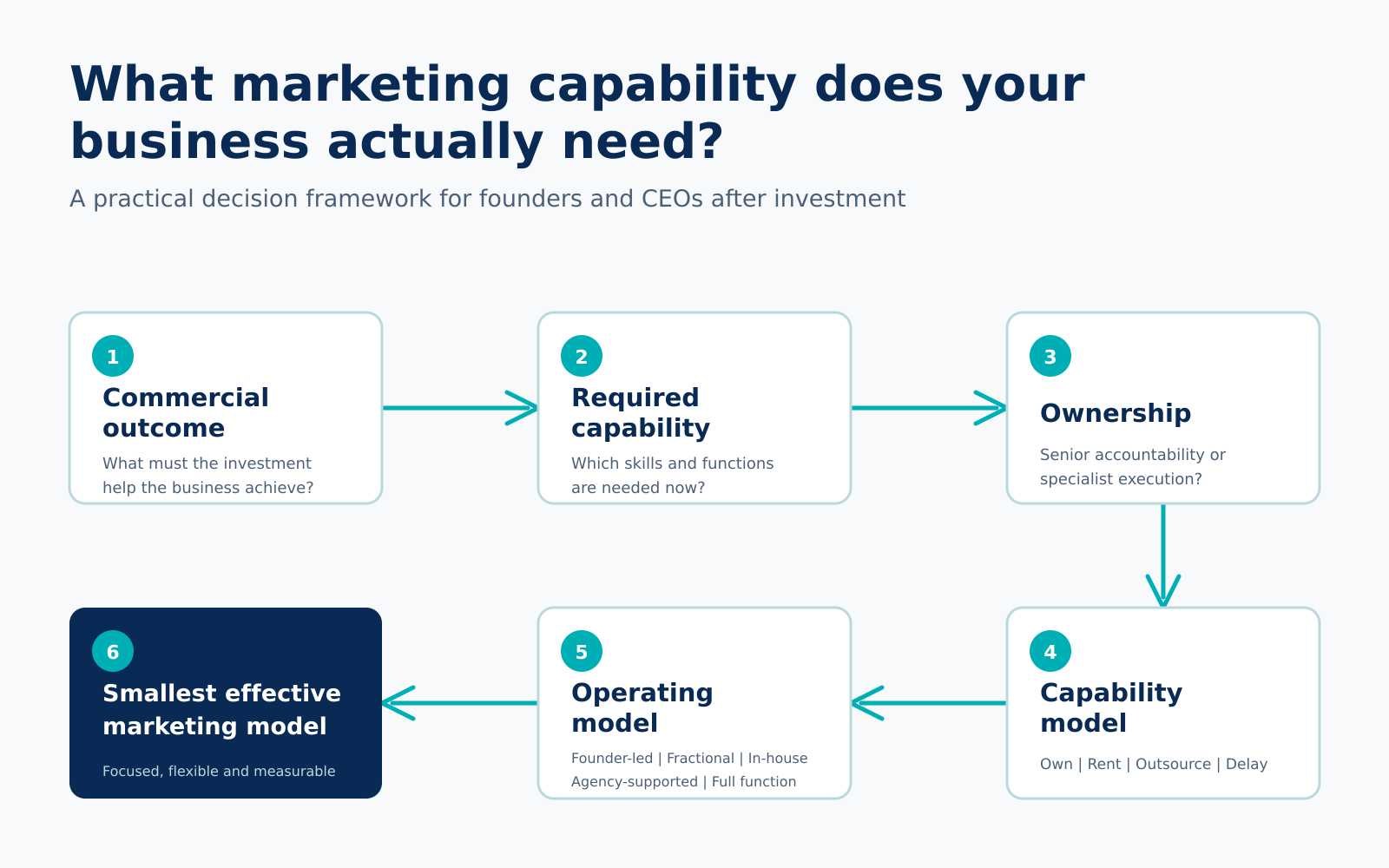
Recognising the need for senior marketing leadership doesn't automatically mean the business is ready to employ a full-time Marketing Director.
A permanent senior hire makes sense when the scale, complexity and ongoing demands of the organisation justify one.
But there is often a stage before that.
The business may need someone capable of setting strategy, aligning marketing with commercial priorities, directing agencies and internal resources, establishing measurement and bringing greater accountability to execution.
It may not yet require that capability five days a week.
This is where fractional or part-time marketing leadership can make sense.
It allows a business to access senior capability at the level it currently needs while continuing to use internal marketers, agencies and specialists for execution.
Senior leadership shouldn't replace the existing team
For established businesses in particular, bringing in external marketing leadership can sometimes be interpreted as a criticism of the existing marketing function.
It shouldn't be.
An internal team often has valuable knowledge of the company, customers, market and history that an external adviser simply won't possess.
The opportunity is to complement that knowledge with something harder to generate internally: distance.
When you're involved in the day-to-day operation of a business, it becomes difficult to step outside it and objectively question established assumptions, priorities and ways of working.
An experienced external perspective can challenge those assumptions, create greater focus and give existing teams clearer strategic direction.
The objective isn't to take marketing away from the team.
It's to help the team become more effective.
What good marketing leadership should create
The output of marketing leadership shouldn't simply be more marketing.
It should create clarity.
Clarity about the commercial objectives marketing supports.
Clarity about priority audiences.
Clarity about positioning and proposition.
Clarity about where resources should be invested.
Clarity about the relationship between sales and marketing.
Clarity about what success looks like.
And clarity about who is accountable for delivering it.
Once those things are established, execution becomes easier to manage because individual activities can be judged against a common strategy.
Before you recruit: is the business ready for that person to succeed?
Recognising the need for a first senior marketing or go-to-market leader is only part of the decision.
The business also needs to create the conditions in which that person can succeed.
Before beginning recruitment, founders should consider:
- Are the commercial expectations for the role clear?
- Are the ICP and proposition sufficiently defined for the incoming leader to build on?
- Does the remit — and the level of seniority being recruited — match the problem the business actually needs to solve?
- Will the person have sufficient budget, resources, decision-making authority and access to leadership?
- Are sales and marketing responsibilities aligned, with clear ownership at the points where they meet?
- Can progress be measured through commercial outcomes rather than activity alone?
- Are the priorities for the first 90 days clear enough to provide direction without prescribing every answer?
For businesses recruiting soon after investment, the post-funding commercial priorities should also be explicit. A new leader cannot align people and expenditure around choices the leadership team has not yet made.
The purpose is not to argue against recruitment. It is to protect the company’s investment and give the incoming leader a stronger starting point.
A focused Growth Strategy can clarify the strategic brief for the role. Where leadership wants a broader view of current capability before deciding what to build, the Growth Readiness Assessment provides a structured starting point.
Before making your next marketing hire
If marketing feels stretched or performance isn't where you want it to be, the instinct may be to add another pair of hands.
Sometimes that's exactly what is needed.
But first ask:
- Is the problem insufficient execution capacity or insufficient strategic direction?
- Are our commercial and marketing priorities genuinely clear?
- Does someone have ownership of marketing performance as a whole?
- Are sales, marketing and external partners working towards common objectives?
- Do our internal team and agencies have sufficiently clear direction?
- Can we explain how marketing contributes to pipeline and revenue?
- Are senior marketing decisions consuming too much CEO or founder time?
The answers can help determine whether the next investment should be in additional execution or stronger leadership.
The right leadership for the stage you're at
Marketing functions shouldn't be designed around an idealised organisational chart.
They should reflect what the business needs at its current stage of growth.
For an early-stage company, that might mean a founder working alongside a capable marketer and selected external specialists.
As complexity increases, fractional senior leadership may provide the strategic layer required to bring those resources together.
Eventually, the scale of the organisation may justify building a more substantial internal leadership team.
There isn't one correct model.
What matters is recognising when commercial ambition and marketing complexity have moved beyond the leadership structure currently supporting them.
Because adding more activity to an under-led marketing function rarely solves the problem.
Giving that activity clearer direction often does.
Key Takeaways
Key Takeaways
- Marketing capability and marketing leadership are different things.
- Increasing marketing activity creates a greater need for strategic direction, not less.
- Misalignment between sales, marketing, agencies and leadership can indicate a leadership gap rather than an execution problem.
- Needing senior marketing leadership doesn't necessarily mean needing a full-time Marketing Director.
- Fractional leadership can provide senior capability while existing teams and specialists continue to execute.
- The objective of good marketing leadership is not more activity. It is greater clarity, alignment, accountability and commercial impact.