Growth Strategy
You’ve Raised Investment. What Marketing Capability Do You Actually Need?
Raising investment creates opportunity, but it also creates pressure to make the right decisions quickly.
For many founders and CEOs, one of those decisions is how to build marketing capability.
Do you hire a CMO?
Bring in a Head of Marketing or Growth Lead?
Use fractional leadership?
Appoint an agency?
Hire specialists?
Keep marketing founder-led for longer?
The mistake is starting with the title or operating model.
The better starting point is the commercial outcome the business needs to create next.
For a funded technology business, that may mean qualified pipeline, customer growth, market expansion or a repeatable go-to-market model.
For an early-stage life sciences business, the immediate objective may be different. It could be investor confidence, strategic partnerships, licensing conversations, category credibility, key hires or preparation for future commercialisation.
Different outcomes require different capabilities.
That is why the first marketing decision after funding is often not a recruitment decision.
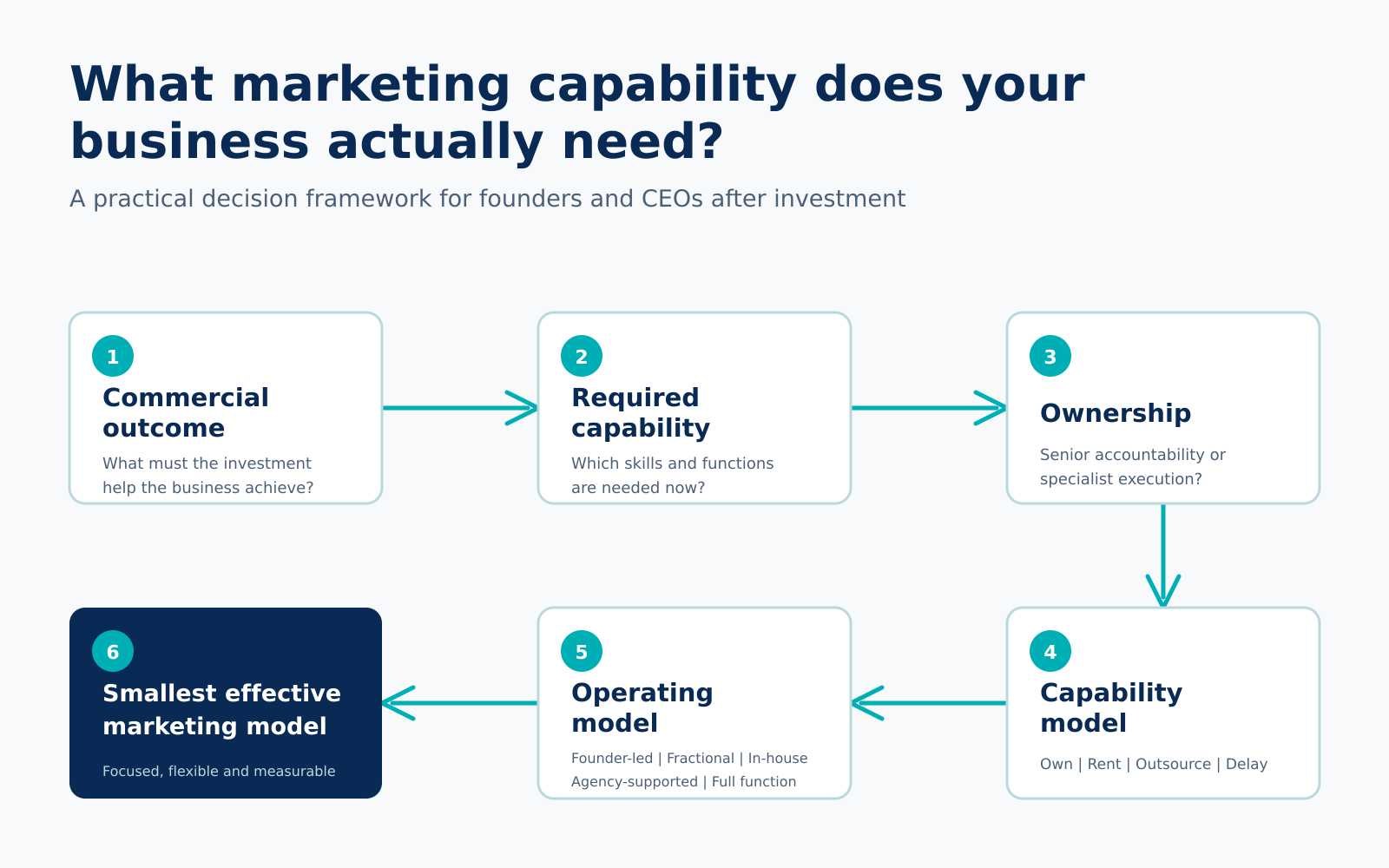
It is a capability decision.
1. Start with the next commercial outcome
Before deciding who to hire, define what the investment needs to help the business achieve over the next 12 to 18 months.
Ask:
- What needs to be different at the end of that period?
- Which audiences matter most to achieving it?
- What evidence of progress will investors or the board expect?
- What is most likely to prevent us getting there?
For one business, success may mean creating a predictable flow of qualified customer opportunities.
For another, it may mean building enough authority and credibility to open conversations with investors, strategic partners or future hires.
This matters because marketing capability should be built around the next commercial milestone, not around a generic idea of what a marketing function should look like.
The post-funding commercial priorities that shape the wider business should therefore be clear before a leadership team commits to a particular marketing structure.
2. Translate the outcome into capability
Once the outcome is clear, the next question is:
What capabilities are required to achieve it?
Depending on the business, that may include:
- Commercial and growth strategy
- Positioning and proposition development
- Go-to-market design
- Brand and category development
- Thought leadership
- Demand generation
- Performance marketing
- Sales and marketing alignment
- CRM and commercial infrastructure
- Analytics and insight
- Experimentation
- Team leadership and coordination
A focused Growth Strategy can help leadership teams define which of these capabilities matter now, how they connect and what can wait.
This is where the widening remit of senior marketing roles becomes relevant.
A CMO, Head of Marketing or Growth Lead may need overall accountability across many of these areas.
That is not necessarily unrealistic.
Their job is to make sure the capabilities work together towards the same commercial outcome.
What is unrealistic is expecting one person to be the deepest specialist and hands-on executor in every discipline.
The senior leader needs breadth, judgement and accountability.
Specialist depth can sit around them.
3. Decide what needs senior ownership and what needs specialist execution
Some decisions have a much greater impact on growth than others.
For example:
- Which market should we prioritise?
- Who is the priority audience?
- What problem are we solving?
- How should the business be positioned?
- What should the proposition be?
- Which route to market makes sense?
- How should investment be allocated?
- What should count as a high-quality commercial opportunity?
These decisions need senior ownership.
They shape everything that follows.
Execution then brings those decisions to life through activities such as:
- Campaign development
- Paid media
- Content
- Creative
- Outreach
- Website development
- CRM implementation
- Automation
- Reporting
The distinction is important.
A funded business can easily hire someone too junior and expect them to make strategic decisions beyond their experience.
Or it can hire someone very senior and then use most of their time on execution that could be delivered more efficiently by specialists.
The strongest model usually separates accountability for the whole system from specialist delivery within it.
4. Decide what to own, rent, outsource or delay
This is where the decision becomes practical.
A useful way to assess each capability is to place it into one of four categories.
Own
Own the capability when it is strategically important, needed continuously and close to the core business.
Over time, this may include leadership, customer insight, product marketing, brand ownership or marketing operations.
Rent
Rent the capability when senior expertise is needed, but not yet on a full-time basis.
This is where fractional leadership can be particularly effective.
A Fractional Marketing Director or CMO can provide direction, set priorities, coordinate specialists and remain accountable for progress while the business is still learning what its permanent structure should look like.
Outsource
Outsource when specialist expertise is required but does not need to sit permanently in-house.
Examples might include:
- Paid media
- Design
- Content production
- PR
- Website development
- Marketing automation
- Specialist campaign execution
Delay
Delay the capability when it does not contribute directly to the next commercial milestone.
Funded businesses can spend too early on technology, communication channels, automation or permanent headcount simply because investment creates the ability to do so.
The useful question is:
What should we own, rent, outsource or delay at this stage?
5. Choose the operating model that fits
Once those decisions are clear, the operating model becomes much easier to choose.
Founder-led with specialist support
Best when: the founder still owns the narrative, relationships and commercial direction.
Strength: close connection to the market and story.
Watch-out: marketing becomes dependent on founder availability.
Fractional leadership with specialist execution
Best when: the business needs senior marketing judgement and coordination, but not yet a full-time CMO.
Strength: experienced leadership with flexibility.
Watch-out: the role needs enough time and authority to influence execution and learn from results.
In-house marketing lead with external specialists
Best when: there is enough ongoing work to justify permanent ownership.
Strength: day-to-day continuity and proximity to the business.
Watch-out: the internal lead still needs access to specialist or senior support where required.
Agency-led execution with internal or fractional strategy
Best when: the business needs execution breadth and speed.
Strength: access to multiple specialist capabilities.
Watch-out: someone still needs to own the commercial objective and strategic direction.
Full in-house function
Best when: the business has sufficient scale, repeatability, workload and budget.
Strength: deep organisational capability.
Watch-out: fixed cost and premature specialisation if the commercial model is still evolving.
The right model depends on stage, objective, complexity and economics.
Not prestige.
6. Allocate the budget across leadership, execution and learning
Once the operating model is clear, there is still a capital allocation decision to make.
A common mistake is to spend too much on one part of the system.
For example:
- Senior leadership with too little budget left for execution
- Execution capacity without enough strategic direction
- Media spend before the proposition is strong enough
- Technology before the underlying process is understood
A more balanced approach is to allocate investment across three areas.
Leadership
Senior judgement, prioritisation and accountability.
Execution
The specialist capability required to deliver the plan.
Testing and learning
The budget and capacity needed to test assumptions, measure response and refine the approach.
For an early-stage funded business, flexibility matters because the right mix will change as the business learns.
The aim is not to lock in the final structure too early.
It is to build enough capability to create progress and generate evidence about what should come next.
Build the smallest effective model
The optimal marketing model is rarely the largest team the business can afford.
It is the smallest combination of:
- Senior leadership
- Specialist capability
- Execution capacity
- Commercial infrastructure
- Measurement and learning
that can reliably create the next meaningful commercial outcome.
For one funded startup, that may mean a founder, fractional marketing leader and a small number of specialists.
For another, it may mean an in-house growth lead supported by an agency.
For a more established scale-up, the right answer may be a permanent CMO and specialist internal team.
The important thing is that the model follows the needs of the business.
Not the other way around.
An independent Growth Consultancy perspective can be useful when the leadership team needs to design this model without assuming that a particular hire, agency or channel is the answer.
A better question for founders
Instead of asking:
Who should we hire?
Ask:
What marketing capability does the business need to create the next stage of growth?
Then decide:
- What needs senior ownership?
- What specialist capability is required?
- What should we own, rent, outsource or delay?
- Which operating model fits the stage of the business?
- How should the investment be split between leadership, execution and learning?
That creates a much stronger basis for deciding how to deploy capital after a funding round.
And it reduces the risk of building an expensive marketing structure before the business is clear about what it actually needs.
The Growth Readiness Assessment provides a structured view of the connected commercial capabilities supporting growth and can help identify where attention may be needed first.