Growth Strategy
After the Funding Round: Five Commercial Priorities for B2B Startups

Raising capital changes what a B2B company can do. It increases runway, creates new options and gives the leadership team the means to move with greater intent.
It also raises expectations.
Investors, employees and the board will want evidence that the business is converting investment into meaningful commercial progress.
But the immediate challenge after a funding round is rarely a shortage of possible activity. It is deciding what should happen first.
The strongest post-funding growth strategy is not a longer list of campaigns, hires and systems. It is a coherent set of commercial choices that gives those investments a shared direction.
Investment should accelerate a coherent commercial strategy rather than fund a collection of disconnected growth activities.
Funding creates choices as well as opportunity
Before investment, scarcity often forces a degree of focus. There are fewer people, fewer channels and fewer initiatives the business can afford to pursue.
Funding removes some of those constraints. Leadership can recruit, expand sales capacity, test new markets, invest in technology and increase marketing activity. Several reasonable ideas can suddenly move at the same time.
That is valuable, but it creates a new constraint: the organisation must decide which opportunities deserve priority and how they fit together.
Without that clarity, different teams can interpret the investment case differently. Sales may pursue the fastest available opportunities. Marketing may broaden the audience to increase demand. Product may prioritise a different market. Recruitment may begin before the company has agreed which capabilities matter most.
Each decision may appear sensible in isolation. Collectively, they can fragment attention and make progress harder to evaluate. Strategic focus ensures that new resources reinforce one another.
Why post-funding growth can become inefficient
Funding can create a strong bias towards visible action. Hiring, campaigns and technology feel like evidence that the business is moving forward.
The risk is that activity accelerates before the underlying commercial assumptions are sufficiently clear.
Common patterns include:
- pursuing several markets because each appears potentially attractive;
- recruiting specialists before agreeing who will provide leadership and set priorities;
- launching campaigns before the proposition is strong enough to support them;
- measuring channel activity rather than progress towards the investment case;
- treating investor confidence as evidence that customer demand is already proven;
- buying systems before defining the commercial process those systems need to support.
These decisions do not necessarily fail immediately. The problem is that learning becomes difficult to interpret when the market, audience, proposition, channel, team and measurement approach are all changing at once.
This is why building the commercial foundations for sustainable growth matters before expenditure accelerates. It creates the shared logic that connects investment decisions.
Five commercial priorities after funding
The precise sequence will vary by business model and stage. However, five priorities help leadership teams turn fresh investment into a more coherent commercial system.
1. Translate the investment case into commercial and value-creation outcomes
Start by making the investment case operational.
What must be different in approximately 12–18 months for the company to say the funding has created meaningful progress?
For some businesses, the answer will involve revenue, qualified pipeline and customer adoption. For science-led and deeptech companies, progress may instead be demonstrated through validation, partnerships, licensing, market entry or evidence supporting a future investment milestone.
Commercial progress does not always mean immediate revenue. It means achieving the outcomes that move the business towards its next stage of value creation.
Leadership should distinguish those outcomes from the task list intended to support them. “Launch a paid campaign” is an activity. “Establish whether a defined audience will enter qualified sales conversations at viable economics” is an outcome and a learning objective.
Agreeing the intended outcomes gives the organisation a basis for prioritising markets, people and spend.
2. Decide which markets and audiences matter most
Investment often increases the number of markets a business believes it can pursue. It does not make every market equally important.
Leadership teams need to decide which segments, organisations and stakeholder groups are most relevant to the immediate value-creation objective.
For a conventional B2B company, this may involve sharpening the Ideal Customer Profile, identifying priority buying situations and understanding the decision-makers and influencers involved. For a business pursuing partnerships, licensing or investment, the priority audience may not be an end customer at all.
Useful questions include:
- Which audience can contribute most directly to the next commercial milestone?
- Where does the business have the strongest evidence of relevance?
- Which opportunities are realistically accessible with the resources and relationships available?
- What will leadership consciously defer, even if it remains attractive later?
Choosing a priority audience does not permanently close other options. It creates enough concentration for the business to learn and make progress.
For companies in the Cambridge ecosystem, proximity to strong technology and life-sciences networks can create many credible opportunities. The same discipline still applies: local access is valuable when it supports a clear strategic priority.
3. Strengthen the proposition, positioning and messaging
New investment can amplify market visibility. It cannot compensate for an unclear reason to engage.
Before increasing activity, the business should be able to explain:
- which problem or opportunity it addresses;
- why that issue matters to the priority audience;
- why the audience should act or engage now;
- how the company differs from credible alternatives;
- what evidence gives the proposition substance.
This is particularly important for companies with complex or technical capabilities. Technical detail may establish credibility, but it does not automatically communicate commercial relevance.
The central proposition should create a consistent position, while messaging interprets that value for different stakeholders. A technical evaluator, buyer, partner and investor may need different reasons to believe in the same business.
If the proposition remains broad, every downstream investment becomes harder. Targeting becomes less precise, sales conversations become less consistent and marketing tends to explain what the company does rather than why it matters.
4. Create a coherent route to market
Once the business is clear about the outcome, audience and proposition, it needs to define how commercial progress will actually be created.
For a conventional B2B model, that means connecting demand generation, sales and customer progression. Lead and opportunity definitions should be agreed. Ownership and handoffs should be clear. The business should understand how demand will be created, captured, nurtured, qualified and converted.
Where paid digital lead generation is relevant, the Lead Generation Budget Calculator can help leadership teams work backwards from an incremental revenue target and test the economics of their assumptions before committing media spend.
But not every B2B company follows a conventional lead-generation model.
The route to market may involve direct sales, account-based engagement, partnerships, channels, licensing, business development, investor engagement or a combination of approaches.
The principle is broader than channel selection. The business needs a shared view of how it will reach and influence the organisations and people whose decisions determine commercial progress.
That view should make clear where marketing contributes, where business development or sales takes ownership and how learning moves back through the system.
5. Build the capability and measurement needed to scale
Strategy only becomes useful when the organisation can act on it.
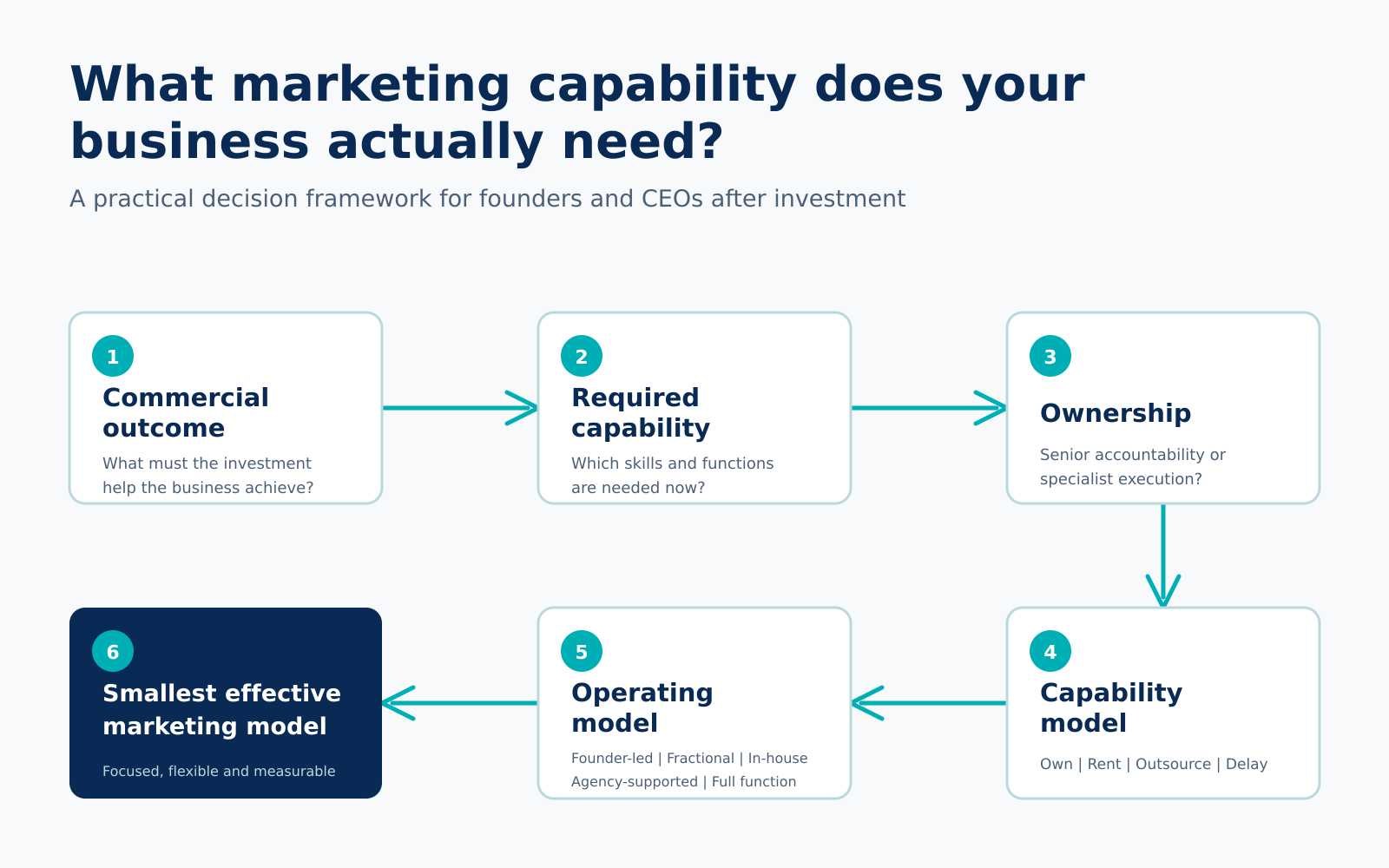
Leadership should decide which capability is required now, which can come from existing people or specialist partners and which may eventually need to be built internally.
A practical view of the marketing capability the business actually needs can help founders separate senior ownership from specialist execution before committing to a permanent structure.
This includes:
- strategic and marketing leadership;
- sales and business-development capability;
- specialist execution support;
- systems and processes;
- reporting and commercial measures;
- decision rights and operating rhythms.
Funding does not necessarily mean immediately building every capability in-house. A company may need experienced leadership before it needs a large team, or a specialist partner before there is enough consistent demand to justify a permanent function.
Measurement should follow the outcomes agreed at the outset. Revenue objectives require visibility through qualified pipeline and sales. Partnership, validation or market-entry objectives require measures of credible progress towards those milestones.
The important point is to avoid scaling activity that the business cannot yet evaluate.
What not to accelerate immediately
Post-funding discipline is not an argument for inactivity. It is an argument for sequence before scale.
Leadership teams should be cautious about immediately accelerating:
- disconnected campaigns without a shared commercial purpose;
- entry into too many new markets at once;
- several uncoordinated specialist hires;
- major channel expenditure without clear audience, proposition and conversion assumptions;
- technology that automates an undefined process;
- lead-volume targets without a view of pipeline economics, where lead generation is relevant.
Focused tests, customer conversations and commercial experiments can begin early. Their purpose should be to reduce important uncertainty and strengthen the next decision, not simply to demonstrate movement.
A practical first-90-day sequence
There is no universal post-funding timetable. The following is a flexible decision sequence for leadership teams, not a formula.
Days 1–30: establish the commercial direction
Clarify the outcomes and value-creation milestones the investment is intended to support.
Review the existing evidence: customer insight, market response, sales data, partnerships, proposition performance and internal capability.
Agree the priority markets and audiences, sharpen the ICP where relevant and identify the assumptions that still need to be tested.
This is also a useful point to use the Growth Readiness Assessment to identify which connected commercial capabilities require the most attention.
Days 31–60: design the operating choices
Agree the route to market and the roles of sales, marketing, business development and leadership.
Define the measures that will show meaningful progress. Decide which capabilities are required, where ownership sits and how budget should be allocated across foundational work, testing and execution.
A focused Growth Strategy engagement can help turn those choices into a shared commercial roadmap rather than a set of departmental plans.
Days 61–90: begin focused execution
Start testing the assumptions with the greatest influence on the strategy.
Concentrate investment behind the strongest current priority. Establish a regular operating rhythm that brings evidence, judgement and resource decisions together. Learn before expanding activity.
Move faster without fragmenting the investment
The objective of post-funding strategic work is not to slow the business down.
It is to create enough focus for the company to move faster without dividing investment across too many disconnected activities.
Funding creates the opportunity to build markets, capability and momentum. A coherent commercial strategy determines how those resources combine to support the outcome that matters next.
For science-led businesses, that outcome may involve partnership, licensing or another enterprise-value milestone rather than a conventional sales model. From Scientific Progress to Commercial Strategy explores how to identify the audiences, evidence and market presence required for that pathway.
Sequence before scale does not mean waiting for perfect information. It means knowing which assumptions matter, testing them deliberately and allowing evidence to shape the next decision.
That is how investment becomes an accelerator of commercial progress rather than simply an accelerator of activity.